

This time last year, we didn’t know a thing about Worlds.
In fact, we hadn’t even played our first tournament on our local tour.
We had no idea what was in store.
Our last post focused on What We Did at Worlds.
This one is about How & Where we Played.
It was only through talking to other families that we learned.
They shared the wonderful experience of playing at Pinehurst.
The competition and the comradery.
Playing well enough for an invite was what they were playing for.
Then we shot a 4-under-par round that essentially was our ticket there.
We won the championship in a play-off & first place Boys 8 for the season.
Our Level 14 (tops beyond Lifetime) was our ticket to unlocking entry.
Still — we were uncertain if we’d go or not.
We’re glad we did.
And we’re glad we brought the whole family.
The Parade of Nations…
The Party at Lake Pinehurst…
The Pool at the Carolina Hotel — where the girls made a friend from Ireland.
A friend they’ve already made plans with next summer!
Now here’s the part — about the golf.
PARENT-CHILD TOURNAMENT
Our first morning at Pinehurst was all about the Parent-Child Tournament.
For 9-10 year old boys the action was at Pinehurst No 6.
A course designed in 1975 by Tom Fazio and his uncle George.
It was our first taste of Pinehurst’s Bermudagrass greens.
Not what we’re used to up north.
It’s a warm-season grass that thrives in the heat & humidity of the NC summer.
First — we had to figure out the direction of the grain -
Which determines which direction it sends chips & putts.
One of our playing partners taught us about the “burned edge”.
It’s the brownish side of the cup that reveals the direction of the grass grain.
Because Bermudagrass grows horizontally — the blades grow across the hole.
So when greens crews cut the cup, the blades growing away from the hole lose support and dry out faster — creating the “burned” look.
We finished our warm-up round at +3.
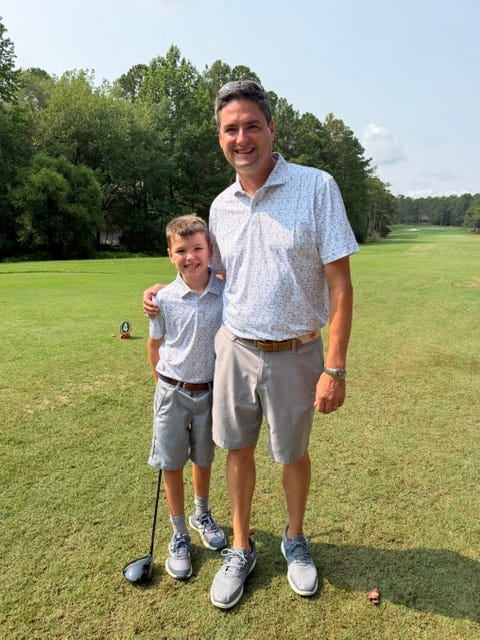
It was great to get out, meet other players and their parents.
And the sisters came along for moral support!
THISTLE DHU
Some of the most fun we had on course — only required 1 club.
Thistle Dhu is an 18-hole putting course.
Pinehurst likes to say it’s 18 holes, requiring only 1 club, and no greens fees.
It’s the unofficial meet-up spot too for friends old & new — at Worlds.
If it sounds a bit like miniature golf — you’d be right.
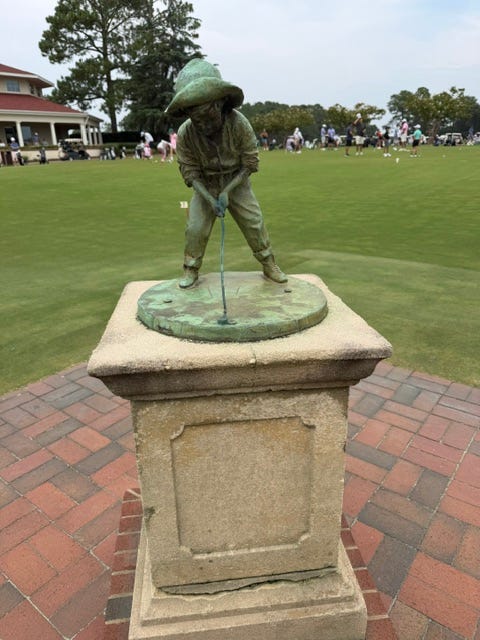
It’s a “Lilliputian course” made by shipping magnate James Barber between 1916-1918.
The story goes that upon seeing its completion he said “This’ll do.”
And the name stuck.
It’s widely regarded as the ancestral birthplace of American miniature golf.
THE CRADLE
Next to Thistle Dhu is The Cradle.
Since Pinehurst is known as the Cradle of American Golf.
The cradle is Pinehurst’s Short Course.
Everyone said we MUST play it.
The locals say it’s the most fun 10 acres in all of golf.
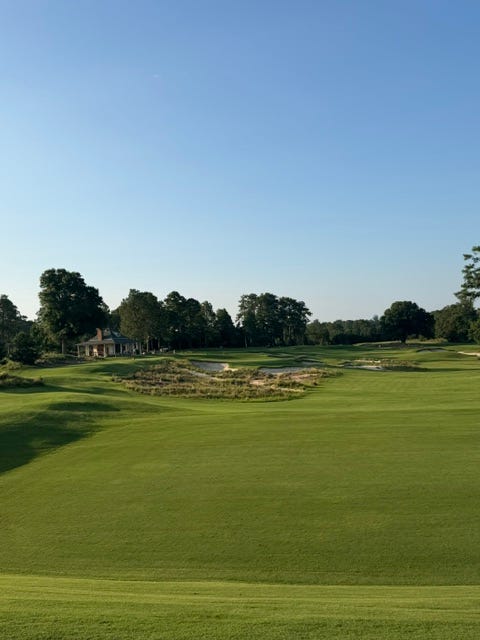
It’s a nine-hole short-game test with various approach angles and deep bunkers.
Undulating greens make up for the lack of length.
We found it challenging — but fun.
It’s tradition to ditch your shoes by the Adirondack chairs near the first hole and play barefoot.
Music is piped in throughout.
And beverages flow at Cradle Crossing — which players conveniently pass twice.
It’s a fun hour to spend with family and friends of all abilities.
THE PRACTICE ROUND
The day before the tournament is the official practice round.
For us, it was our first shot to check out Pinehurst No 1.
It’s the original — where it all started.
Built in 1898.
The course runs along the historic Pinehurst Harness Track.
Just over 6,000 yards from the tips.
An authentic Donald Ross design.
Many folks play it as a warmup to No 1 — next door.
We had great playing partners for the day.
In fact we were even paired with a family we’d played with earlier this year at Round 2 of the Under Armour Winter Nationals in West Palm Beach.
ROUND 1
The first thing we noticed early Thursday morning for warmups at the range.
It was so quiet — you could hear a pin drop.
Everyone just working on their pre-game on Maniac Hill.
That’s the nickname for the practice ground at Pinehurst…
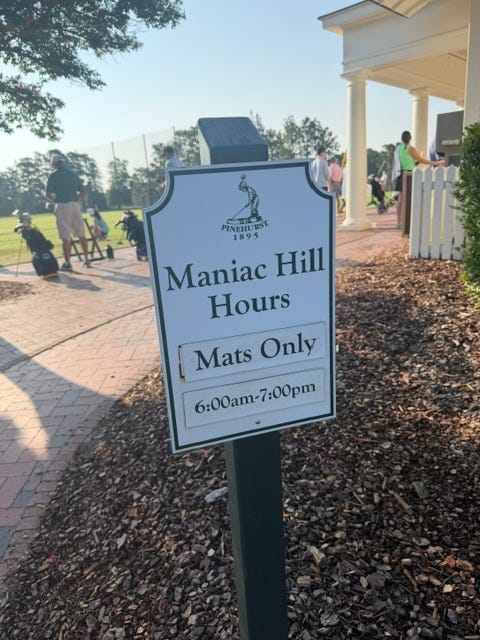
Where an estimated 10 million or so balls are hit — every year.
We were confident heading off the Hill.
That confidence melted on Hole 2 when we hit a tee shot into the pine straw.
It launched a series of 6 back-to-back bogeys from which we never recovered.
We’d finish +10.
Made all the worse because we were paired with some top players, thanks to our Level 14 status we presume, who both shot under par for the round.
We vowed to fight back, Friday — “Moving Day.”
ROUND 2
Friday went much better than Thursday.
13 pars and 5 bogeys.
None until Hole 5.
And still no birdies.
We were battling a chronic swing issue flare-up.
But making it work better than the day before.
And firmed up our mental game.
ROUND 3
Same score as Round 2.
But the day went much different.
Irons fixed. But putter was a battle.
And the mid-day tee time meant much slower greens than the past 2 mornings.
Finally got a birdie.
But also got a double.
12 pars — 4 bogeys.
Not our best.
But still a great experience.
Overall — landed about middle of the pack.
We met and played with great players from the U.S. and abroad.
Met up with some old friends.
And were proud to represent Maryland as the only Boys 9 player.
WHAT’S NEXT
It was great to get the lay of the land at World’s this year.
Even better —
We know we’ve qualified for 2027.
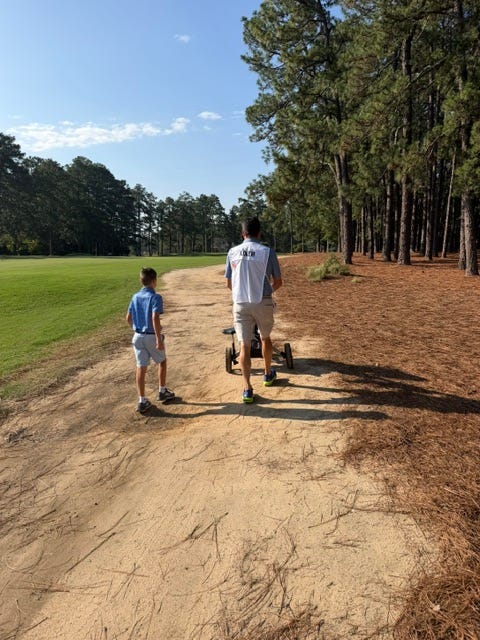
And we know we’ll be back.
That's quite a head start compared to where we were a year ago.
We’re wrapping up the local Summer Tour in Northern Virginia.
And looking forward to the Fall Tour in Central Maryland.
Our goal is to keep working on the game…
Seeing new courses…
Meeting new friends…
And having fun together as a family.
Our week in Pinehurst coincided with Shark Week, which we watched each night back in the hotel before our early wake-up times. It felt oddly appropriate. Every young golfer at Pinehurst — chasing something that can seem just as elusive as a great white—a breakthrough, a personal best, or a world championship.
There was one more lesson we carried with us all week. Before we headed South, Mason’s best friend offered one simple piece of advice: “Be the goldfish.” It’s the line made famous in Ted Lasso—a reminder that goldfish have short memories.
In golf, that’s essential.
Hit a bad shot? Forget it.
Make a double bogey? Move on.
The next swing deserves your full attention.
Words to live by.
We — like many of the other families this past week — made a point to stop by the Payne Stewart statue behind the 18th green of Pinehurst No 2.
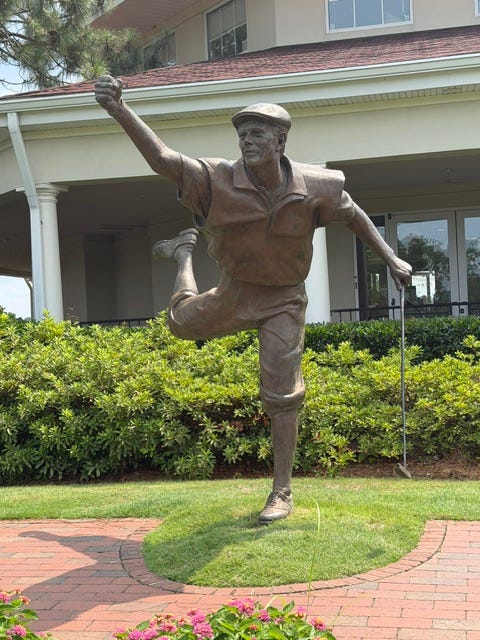
It's a reminder that success isn't built on perfect rounds—it's built on perseverance.
The statue commemorates Stewart’s iconic celebration at the 1999 U.S. Open — sinking a dramatic 15-foot putt to seal a victory over Phil Mickelson.
It came one year after a heartbreaking loss in the tournament at the Olympic Club to Lee Janzen… and just four months before his tragic passing.
The statue captures an unforgettable moment — Stewart's famous fist pump — but its message is about much more than a winning putt.
It’s a story about perseverance, heartbreak, resilience and refusing to quit.
Maybe that’s the real lesson from Pinehurst.
Be the goldfish when things go wrong.
Be like Payne Stewart when it comes to your dreams.
Dreams aren’t realized because everything goes right.
They’re realized because you keep believing—even when things go wrong.
As for us, we’ll keep working, keep dreaming and keep showing up. We’ll see you back at Pinehurst next year.