

We played the same golf course in two different junior competitions this month.
The outcomes couldn’t have been more different.
And it had very little to do with skill.
It had everything to do with the way the course was set up.
Our first visit to Twin Lakes came on the MAPGA Junior Tour in the Intro Boys Division.
After two seasons in Mini Mulligans, we decided it was time to move up.
Mini Mulligans is a wonderful introduction to tournament golf for boys and girls ages 7-10, with nine-hole yardages between 1,400 and 1,700 yards.
The Intro Division is designed for ages 9-14, with courses ranging from 2,300-2,700 yards.
Our first event in the division went well. At Compass Pointe, he won the tournament from 2,459 yards despite being the youngest player in the field.
Then came Twin Lakes.
This time, the course measured 2,629 yards.
He struggled to reach greens in regulation, finished 10-over, and walked off frustrated.
A week later we returned to the very same course.
But this time it was a U.S. Kids Golf tournament.
He competed in the Boys 9 division.
The yardage?
2,119 yards.
That’s 510 yards shorter—roughly the equivalent of removing two to three golf holes over nine holes.
Nothing about his swing had changed.
The course had.
Fair Before Handicap
U.S. Kids Golf’s philosophy is fairness should be created before the first shot is hit.
Instead of adjusting scores after the round with handicaps, they adjust the golf course before play begins.
Players compete against others their own age on tees designed for their stage of physical development.
The goal: Children should be able to play the course much the way adults do.
That means having a realistic opportunity to:
Reach most par 4s in regulation.
Face meaningful risk-versus-reward decisions.
Use every club in the bag.
Make scores reflect skill rather than simply hitting the ball farther.
Develop creativity around the greens instead of merely trying to survive the course.
The yardages are based on the Longleaf Tee System, developed by U.S. Kids Golf in partnership with the American Society of Golf Course Architects Foundation.
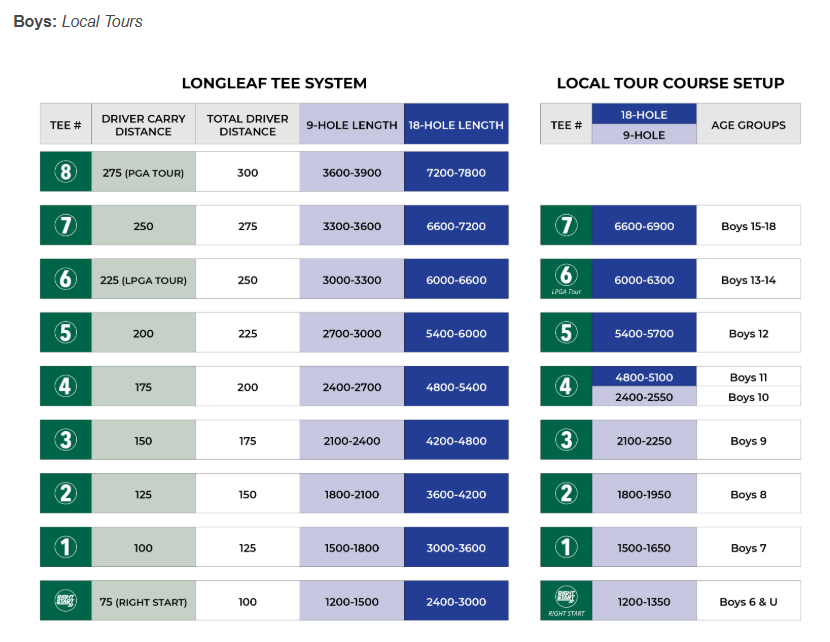
As players grow, the tees gradually move back, ensuring they continue facing similar scoring challenges throughout their development.
Different Ways To Achieve Fairness
This experience also reminded me that fairness can be achieved several ways.
In junior competitive golf, fairness comes from adjusting the course.
Age-based divisions and age-appropriate yardages allow juniors to compete on equal terms while preserving the integrity of gross-score competition, where the lowest actual score wins.
In recreational amateur golf, fairness comes from adjusting the score.
Golfers of different abilities play the same course, and the handicap system awards strokes based on playing ability so everyone can compete together.
Both approaches are fair.
They simply solve different problems.
Watching the same nine holes play so differently in consecutive weeks was a powerful reminder that the right-sized course gives juniors the opportunity to play the game the way it was meant to be played.
Where Do High School & College Golf Fit?
As junior golfers mature, the definition of fairness evolves.
By the time players reach high school and college golf, they’re generally competing from the same tees within their division, with no handicaps. Fairness no longer comes from adjusting the score or significantly adjusting the course by age—it comes from ensuring every competitor plays the same test under the same conditions.
That shift makes sense.
As players become physically stronger and more consistent, developmental differences narrow, and course setup becomes less about accommodating growth and more about identifying the best performer.
It’s the same model used in amateur championships and professional golf: everyone plays the same course, under the same rules, and the lowest gross score wins.
Viewed as a progression, the system makes a lot of sense:
Junior developmental golf: Adjust the course to fit the child.
High school, college, and championship golf: Everyone plays the same course.
Recreational golf: Adjust the score through handicaps so golfers of different abilities can compete together.
To summarize… Junior golf adjusts the course. Championship golf tests the player. Recreational golf adjusts the score.
All three are fair—they’re simply designed to answer different questions.