

There’s a growing conversation among parents in our circles and beyond about something many of us feel but haven’t confronted: how to approach youth sports.
Each season juggling the maddening schedules.
Which with multiple active kids — can be quite complicated.
Things have certainly changed since many of us put on the uniform and met up with our friends for the love of the game or thrill of competition.
A recent House subcommittee hearing declared a crisis in youth sports for a number of reasons — the high cost of entry for elite leagues and the atrophy at the local level.
Here at Family Golfer — our kids are active participants in youth sports.
They’ve played tee ball, soccer, softball, tennis, swim team and flag football.
Fortunately we live in an area with a robust community league.
But when a team doesn’t fit our philosophy, we don’t continue.
For instance, when the coaches of a 2nd year tee-ball team stated if our kids had any inclination to want to play high school ball, then they needed to do X, Y, Z — that was the end for us.
Coaches who, at this age, want to pigeon hole a player into a certain position, also don’t match our mentality.
Not every family is so fortunate, because in places where options are limited, kids are losing out on the physical and social benefits of organized play.
And while kids are missing out…
The business of youth sports — is booming.
To the tune of about $40 billion annually.
Pay to Play
For many families, the youth sports bill has become shockingly high.
According to the Aspen Institute’s Project Play Initiative:
Parents now pay more than $1,000 a year for a single child’s primary sport.
Travel teams, private coaching, tournaments and competitive leagues can easily push that number to $3,000 or more annually.
For some the price tag can reach upwards of $20K.
The study’s co-author points to the pandemic for the rise in expensive trainers and club teams, writing “many families doubled down, trying to make up for lost time.” Parks and Rec budgets were already devastated by the 2008 financial crisis and private equity firms came in to fill the gap with flashy, elite club teams.
While innovators brought back access to quality programs, the landscape is disjointed.
Less Participation, More Pressure
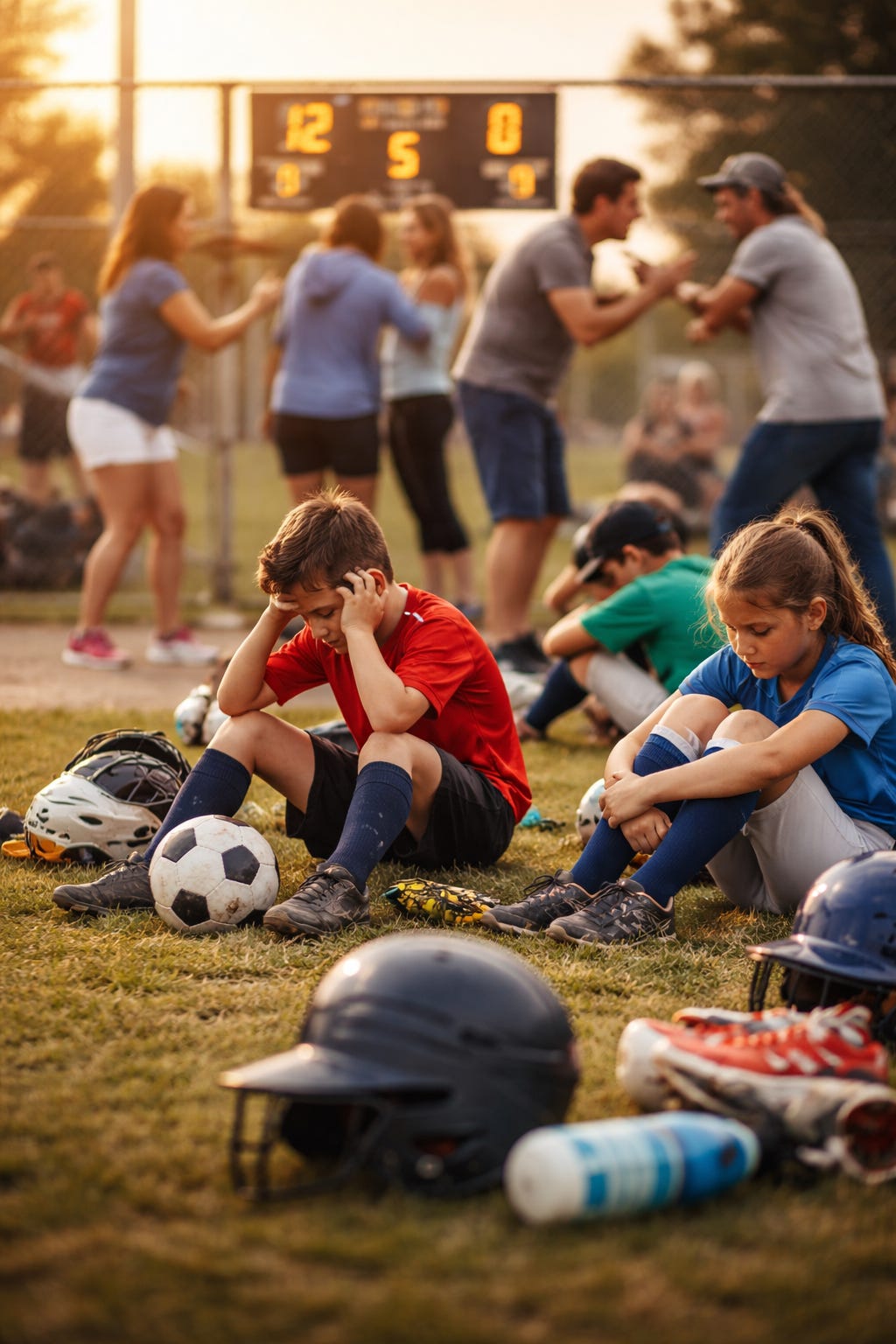
Just because families are spending more, doesn’t mean kids are playing more.
Participation has dropped — from about 61% pre-pandemic to roughly 55% today.
One statistic suggested that up to 70% of children quit organized sports by age 13.
So what is happening?
More pressure to specialize and compete early | Kids are encouraged to join travel and elite teams, sometimes at the expense of fun and community leagues.
The “scholarship promise” | Parents are sold the false promise that early specialization will lead to scholarships — even though only a tiny % earn them.
Private equity and commercialization | Some witnesses suggested that big business has pulled community programs into profit-driven structures.
And when kids don’t play, they lose the chance to build confidence, teamwork, discipline and social skills — skills that extend far beyond the field or course.
The ripple effects — are real.
What Can Families Do?
While Congress debated policy solutions, including funding and market reforms, many of the most practical steps start closer to home.
What’s In Your Backyard?
Local parks and recreation programs offer some of the most affordable, inclusive opportunities to be active without breaking the bank.
Branch Out
Encourage kids to explore a variety of sports rather than specialize early, reducing burnout and the pressure to commit solely to expensive travel teams.
What Does Your Child Love
Instead of “What sport will get my child a scholarship?” ask, “What does my child love?” Many kids just want fun, fitness and friends.
Mind The Gap
Only 6% of high school athletes play in college, less than 1% of those get drafted into professional sports. Yet the Aspen Institute’s Project Play National Parent Survey shows 20% of youth sports parents believe their child can play D1 sports, while 10% believe their child can reach the pros or Olympics.
The ultimate goal — sports as a tool to develop better character and health.
And if you land a scholarship, even better.
Finding the coach, league or team that supports you in this — is key.
Our Story
Often the interest is there, but the opportunity is not.
Case in point — our public school district’s commitment to athletics.
This year, rolling out a Middle School Sports Program.
A full slate in the Fall: Basketball & Track
And in Winter: Bocce & Flag Football
This Spring: Soccer & Cross Country
On the girls side — a fraction of those who tried out made track & field.
And only half made flag football in the winter.
The demand couldn’t meet the resources.
Our daughter was a relative late-comer to softball at age 12.
Only even considering it because of a unit in gym class —
When her P.E. Teacher asked her if she played.
She hadn’t.
We put her in Fall Ball… and the rest is history.
Except next year we’re headed to high school.
And are told only the Travel Girls make the school team.
So there’s that.
In last month’s testimony, Tom Farry, executive director of Aspen Sports & Society, said it comes down to rethinking the model:
“One of the problems we have here is there’ll be 80 kids who try out for the boys’ basketball team… And 15 will make it, and 9 will get playing time, and we structurally push aside kids because of our traditional structure of school-based sports.”
The ADM
At the end of the day, golf’s American Development Model points to a simpler, healthier way forward — one that puts kids and families first.
It works best when programs commit to:
Meeting kids where they are developmentally, focusing on basic movement and fundamentals before competition to reduce burnout and build confidence.
Lowering the barrier to entry, so cost doesn’t determine who gets to play.
Encouraging multi-sport participation, helping kids a love of the game.
Keeping golf fun, engaging and flexible, with room for free play and enjoyment.
Investing in quality coaching, where adults understand how to keep kids engaged.
If youth sports are facing a crisis, models like this offer a practical solution. Build better foundations, widen access and make the experience enjoyable.
Together we can help build healthier kids, stronger families and sports that last.
